
We spend a chunk of our time today trying the ChatGPT operator.
Not “trying” like testing it. Trying like punching in the same sentence four different ways just to get one usable answer. No one asked for this. It’s just how search looks now.
You used to Google “best day cream for oily skin” and get ten links, a box of ads, and a dermatologist’s blog. Now, you’re asking Claude, Gemini, or ChatGPT which product works better when it’s 42°C and you’ve slept for four hours. You’re not just searching. You’re confiding.
This is not SEO anymore. This is GEO. AEO, AIO, LLMO.. and so much more.
AEO, GEO, AIO, LLMO — What These Mean and Why They Matter
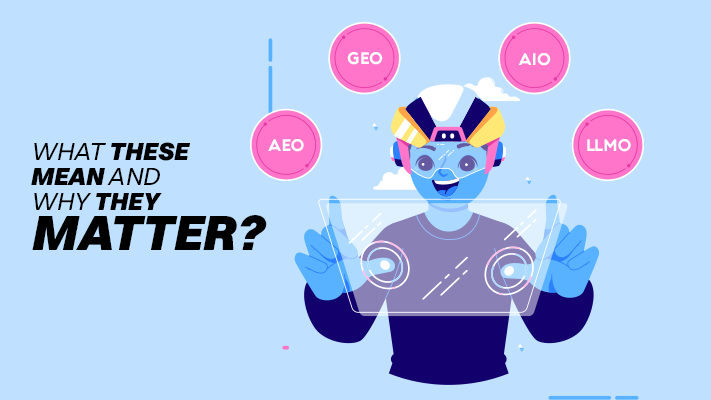
Search is evolving into smaller pieces. Each piece has its own rulebook. Here are the terms that brands need to understand in 2025.
GEO (Generative Engine Optimization)
Helps your brand appear in answers given by ChatGPT, Gemini, and other AI tools. These tools do not list websites. They give direct replies. GEO helps your content become part of those replies.
AEO (Answer Engine Optimization)
Focuses on showing up in rich results like FAQs and featured boxes on Google. These are short, helpful answers placed above regular links.
AIO (AI Interaction Optimization)
Makes your website respond better to users through AI tools. This includes personalized content, AI chats, and tools that guide users based on their needs.
LLMO (Large Language Model Optimization)
Prepares your content for AI tools that read and remember information. This helps you show up in future responses when someone asks a related question.
Each of these areas needs clear, structured content. Together, they shape how people discover and trust your brand today. But today we are going to focus on GEO
What is GEO?
GEO stands for Generative Engine Optimization. The idea is simple: if search is being mediated by large language models, then your brand content needs to be written, tagged, and structured to make it into the LLM’s answer window. Or what the industry politely calls a “zero-click response.”
But this isn’t just an upgrade from SEO. It’s a real shift in how people find, trust, and choose.
“Roughly 27% of U.S. adults now say they use AI like ChatGPT for search. In Gen Z, that number is already above 50%.”
— Pew Research Center, June 2024
So if your website isn’t visible to LLMs, you’re not invisible to Google. You’re invisible to the internet.
AI SEO Strategies 2025: What’s Changing?
 Recent google updates provide a great blueprint for making sure you are on track. But for now, let’s breakdown how this shift plays out in practice.
- People don’t want links.
They want a decision made for them. “What’s the best anti-dandruff shampoo with no sulphates and under ₹600?” That’s not a keyword. That’s a question looking for one clear, smart, fact-checked answer. - Search is getting weirder.
LLMs are being trained to synthesize answers from multiple sources. This means your blog on sulphate-free shampoos could be quoted next to an ingredient database and a Reddit thread without your name even showing up unless your content is structured right. - Search is getting personal.
AI is context-aware now. It adapts to the user’s tone, device, preferences, and past queries. Your brand needs content that is equally fluid: structured for bots, but human in tone.
GEO Optimization for Brand Websites: The 2025 Checklist
Most brand websites today are not GEO-optimized. They are designed for humans to browse, not for machines to read and cite.
Here’s where that changes:
1. Structured Data is Non-Negotiable
Use schema.org markup across your entire site:
- Product schema with ingredients and availability
- FAQ schema for conversational answers
- Review schema with source and sentiment clarity
This is what gets you indexed not just by Google, but by Claude’s memory bank and ChatGPT’s browsing layer.
2. Introduce llms.txt on Your Domain
This is the next robots.txt. This is a signal to generative engines outlining what parts of your site can be accessed, quoted, or summarized.
“OpenAI now crawls via GPTBot, and Google’s Search Generative Experience respects a similar framework. Brands that adopt llms.txt early are already seeing inclusion in AI snippets.”
— TechRadar, April 2025
3. Build for Multi-Intent Queries
A skincare brand shouldn’t just write about “best sunscreen.” It should have individual pages for:
- “best sunscreen for Indian skin tones”
- “best sunscreen for oily skin under ₹500”
- “SPF vs PA++ explained”
These are the kinds of queries ChatGPT summarizes from.
Each one needs original content and clear markup.
Real People Are Changing Their Search Habits
Let’s skip the theory. Here’s what’s happening:
- Search fatigue is real. People don’t want to sort through 12 blue links.
- Voice search and GenAI search are overlapping. “Talk to Google” is now “Talk to Gemini.”
- Context beats keywords. Users are typing full stories. “I’m looking for shoes for flat feet that don’t look like orthopedic clogs and can survive Mumbai rain.” That’s one search. And you need to answer it without blinking.
“Gen Z users are skipping traditional search and heading straight to AI chat tools, where they trust the conversational tone over ad-heavy SERPs.”
— Vogue Business, March 2025
So now, the question isn’t: is your page optimized for Google? The question is: can your page be quoted by ChatGPT?
AI Discoverability Tips for Indian Brands
Let’s get more local. If you’re a brand in India, here’s what matters right now:
- Local language indexing: Hindi, Tamil, Gujarati.. generative search is training on regional language queries. Have multilingual support.
- Visual tagging: LLMs now process alt text to generate image summaries. Use precise, descriptive captions for product images.
- Zero-click answers: Your goal is not traffic. It’s mindshare. Be the brand name mentioned in the first answer, even if no one clicks the link.
And above all:
Stop writing like a robot. The content needs to be helpful, vivid, and complete in one shot. The AI is the reader now, and it has no patience for vague copywriting.
Why GEO is a Brand Strategy, Not Just SEO Tactic
Generative Engine Optimization is not just technical. It’s reputational.
You don’t just want to be discoverable. You want to be cited. You want the AI to say your name out loud. That’s what wins in 2025.
This means your team needs to think like this:
- Writers and strategists should treat every page like it’s a source for a New York Times article.
- Developers should tag and structure content like they’re building for a machine with memory.
- Designers should think in content modules, not static layouts.
How to Optimize for GEO, AEO, AIO, and LLMO
Use these quick, simple steps to improve how your brand appears in AI-powered search and conversations.
GEO
- Write complete answers in short paragraphs
- Use natural phrases that match real user questions
- Keep formatting clean and consistent
- Highlight key facts with subheadings and bullet points
AEO
- Add FAQ schema on all relevant pages
- Include clear answers for very specific queries
- Keep your answer length between 40 to 60 words
- Update content based on the latest search trends
AIO
- Add AI-powered chat tools to help users explore faster
- Build flexible pages that can change based on user behavior
- Create tools like product quizzes and calculators
- Match the user’s tone and intent in every message
LLMO
- Add an llms.txt file on your domain
- Use clear labels and structure in all page content
- Write accurate, well-sourced information
- Link pages with useful, readable anchor text
Each step adds more value to your content. Over time, this builds better visibility, trust, and engagement across all AI-based systems, thereby boosting your marketing.
Build a Website that Gets Quoted In AIO
In 2025, ranking is just the baseline. The real prize is being the answer, not one of the options.
We’re already helping our clients at Infiniqe Marketing rebuild site structures, upgrade content flows, and implement llms.txt protocols for maximum generative visibility.
GEO is not optional anymore. It’s your new homepage.